7 Aralık 2012 Cuma

Vampyre Nation – review

To contact us Click HERE
Director: Todor Chapkanov

Release date: 2012

Contains spoilers

The Sci-fi channel does it again… Whilst this is airing in the UK as Vampyre Nation the fact that it is also called True Bloodthirst shows that it is essentially ripping off other genre pieces. As well as True Blood (not only the name but the fact that vampyres – as spelt in film – are out of the coffin thanks to the development of synthetic blood), there is a huge slab of Blade 2 with a smattering of Daybreakers - oh, and let us not forget a name borrowed from Dracula.

Now, I know the genre is one built on borrowed concepts, outright thefts and lore evolution but this was just so very blatant. The question is, was it any good…

man-bat
We are in Bucharest and a man (Joro Zlatarev) walks down a line outside a club, a vampyre openly feeds. He goes to the bouncer (Dimitar Ougrinov) and says that he wants to see Grigori (Velislav Pavlov). He is sent round to the back of the club where he is met by Grigori and two other vampyres. He is trading AB -ve blood, very rare he says, for cocaine. Grigori has worked out he is the source but his 'from the neck feed' is interrupted as a large bat creature appears. It kills all three vampyres and the blood dealer.

Nail Jackson as Derricks
Over the credits we hear bits of news reports that mentions the vampyre virus, synthetic blood, vampyres being moved to Bucharest sector 5 – a quarantine zone that is more like an internment camp, and Konstantin Kovacks (Roark Critchlow) being made head of the Department of Vampyre Relations (DVR). We watch cop Derricks (Neil Jackson, Blade the Series & The Thirst) arrive at the DVR. A vampyre entering the building has mislaid his pass, Derricks takes him to one side until he finds it. The vampyre points out that he empties Derrick's bins and deserves respect. I liked the fact that a sign mentioned strigoi as well as vampyre.

Andrew-Lee Potts as Harker
Derricks wants in on the attack at the club and Kovacks admits that there have been similar attacks. He puts him on the case but tells him that he has to take Scotland Yard detective Innes-Bunchley (Jonathan Hargreaves) as a partner. Derricks says he wants John Harker (Andrew-Lee Potts) and Kovaks agrees if he takes Innes-Bunchley too. Harker is in a prison fight along with his friend Andrei (Vlado Mihaylov) – his freedom is offered for working with Derricks. Harker wants his sister, Celeste (Heida Reed), freed as well. They, along with his girlfriend Katya (Claudia Bassols), are vampyrgia (however you spell it) – vampyre hunters. The specifics of their incarceration is not given but one assumes it was for killing vampyres.

Ben Lambert as Nikolai
When they go – tooled up – to the vampyre club they meet Nikolai (Ben Lambert) second in command to his 600 year old sire who says he campaigned with Vlad Ţepeş – though later dialogue actually suggested he is Vlad Ţepeş. They tell them that the attacking man-bat creatures are vampyres infected with a retrovirus that devolves them, increases their metabolism even more than vampyres and thus makes them voracious – so whilst they look like the subsiders from Daybreakers the plot is pure Blade 2. Indeed the retrovirus is man-made and a conspiracy is unearthed whilst vampyre hunters and human hunters have to learn to work together.

killing a bat creature
Other lore; mercury will kill vampyres and silver burns, they burn in sunlight; we see one burn with head and hands exposed but they seem to be ok with a hood, shades and scarf – despite exposed foreheads. They heal quickly, have night vision, superior hearing and drinking a vampyre’s blood is enough to ensure turning. The bat creatures can be herded with the use of a sonar signal and they dust in a flash of light leaving a skeleton that then crumbles.

working together
The plot was simply lifted, as I say, though it had a sub-text of racial tolerance running through it. Some acting was okay, for instance Neil Jackson was rather good, but other acting was terrible - Jonathan Hargreaves’ English detective was painful to watch. Some accents appeared and disappeared and whilst his performance wasn’t too bad, and he seems a likeable cheeky chappy, Andrew-Lee Potts is just too baby-faced to pull off the big, bad vampire hunter.

kind of sub-Blade 2
The cgi was blooming awful and, of course, this relied on it and generally the film was just a sub-standard Blade 2 rip off – even the boss vampire was a red robed, bald vampire living in a castle like crypt. All in all pretty poor, but not the worst thing I’ve ever seen. 3.5 out of 10.

The imdb page is here.

Honourable Mention: Blood soldier: Interrogation

To contact us Click HERE
This is a short from 2011, directed by Jake Thornton and seems to be a test piece for something larger – at least I hope so.

It begins with a pipe and we realise we are in some form of bunker, visions of a woman (Siri Baruc, Blood Angels) flit across the screen, she laughs happily. Captain Marcus Cole (Neil Jackson, Blade the Series, The Thirst & Vampyre Nation) bolts awake from his dream, he throws up and the vomit is composed of blood.

Mandy Amano as Vasquez
Colonel E Stracken (John Knox, Vampire Vixens from Venus) is interrupted in his paperwork by Thalia "Desert Cobra" Vasquez (Mandy Amano) who tells him the new Captain is awake. I have to say I loved the sci-fi look they gave her, at odds with the Afghanistan story setting but it worked well. Stracken has a file on Cole.

Layla Alizada as Leena
Cole is placed in a room, there is a table and a couple of chairs. He notices cameras and Stracken speaks to him via a microphone. He explains that Cole is now a dangerous weapon and this is a test of loyalty. Vasquez brings in a gagged woman, Leena (Layla Alizada), and from the interaction between Cole and Vasquez it is clear they have met before. Before she leaves the interrogation room she cuts at Leela with a combat knife, opening shallow wounds and licks the blood from the knife.

The Squad
Outside, Vasquez and two others, William "Bull" Hawking (Anthony Ray Parker , Xena Warrior Princess: Girls Just Wanna Have Fun) and Theo "Dire Wolf" Valance (Jeff Schine), comment on how Cole will do. Stracken explains to Cole that she is an insurrectionist, an enemy combatant. She holds information they need and Cole must get it out of her before he kills her.

will he have self control?
Given the fact that this is TMtV, you know he is now a vampire but will he kill the woman… You can find out in the embedded short below. I was rather impressed; it is only a teaser, a taste of a larger story, but it is a story I’d like to see.

The imdb page is here.


Blood Soldiers: Interrogation from Stone Tiger Productions on Vimeo.

Redemption – review

To contact us Click HERE
Author: Susannah Sandlin

Release date: 2012

Contains spoilers

The blurb: Not since Charlaine Harris' Sookie Stackhouse series has a sexier band of vampires roamed the American South. Fans of paranormal romance will be captivated by the immortals of Penton, Alabama, introduced in this début novel from Susannah Sandlin’s thrilling new series.

The world’s vampire population is on the brink of starvation. Since the vaccine for a global pandemic rendered human blood toxic, the vampires’ only hope for survival is to find unvaccinated humans to be donors. In the tiny town of Penton, Alabama, four-hundred-year-old Aidan Murphy has created a rare haven from the famine, a place where vampires and pure-blooded humans peacefully coexist. But when his estranged brother descends upon Penton to wreak havoc, Aiden makes a desperate choice. He kidnaps an unvaccinated human doctor to replenish their food supply—and finds himself falling in love for the first time in nearly four centuries.

The review: I don’t know why I do it… subject myself to the occasional paranormal romance… wait, I do… it’s because the ones I read have vampires in them and this one has floated like literary flotsam and jetsam into my awareness. And thus I read it

The thing is, some paranormal romances work; they prove themselves to be well-written and, whilst not my favourite sub-genre of books (at all), have a lot to recommend them—especially to those who actually are fans of the romance genre.

This was, unfortunately, not the case with Redemption. The author certainly came up with an interesting starting idea. A pandemic vaccine that makes humans poisonous to vampires was a really good starting point. Now the blurb mentions kidnapping a human doctor, Krys, to replenish their food supply and this does the plot a disservice. She is kidnapped because they do not have a doctor and the bad vampires are up to no good, injuries are expected.

Of course, despite this creepy start to their relationship, they are bound to be star crossed lovers destined for each other. It is here where the book faltered, in the romance. There was a good general story idea and the author has to spoil it all by having a character say something stupid like “I love you”.

The romance sections were, frankly, turgid. I had to wade through them and wait to get back to the more interesting narrative. These sections needed honing however. The fact that, should a vampire bind a human to them, only members of their scathe (a metaphysically bonded group of vampires) can feed from them, and so bad guy Owen can’t just take the humans in the town, made the slowness of his actions implausible. The fact that he takes so long getting around to killing his brother (which would free the food supply and grant him a pardon from a death sentence at the hands of the vampires’ ruling tribunal) was unbelievable and simply served to pad the story. The alleged desertion of one of Aidan’s top vampires was too simplistically handled, and Owen’s attempt at urban terrorism rang hollow when it was clear that a bomb he set off would kill more human food-stock than vampires.

However there was a potentially nice little baseline story that just needed polishing – just the romance needed ditching. 4 out of 10.

First reviewed at Amazon UK as part of Amazon Vine.

Classic Literature: The Vampire of the Val-De-Grace

To contact us Click HERE
A friend bought me, a couple of years ago, Le Vampire Du Val-De-Grace as that print of the novel by Leon Gozlan was listed, on Amazon, as being in English. It wasn’t… So I was most excited when the wonderful Blackcoat Press announced an English translation by Brian Stableford.

I think it is worth taking time to reproduce the blurb, though there are some dating issues within:

“I wasn’t able to steal her away while alive: “I’ll come and steal her away when I’m dead!”

In 1849, the mysterious Doctor Salomon Kanali and his family arrive in a Paris ravaged by a cholera epidemic. But is this Kanali the same embalmer who claimed to have the power to resurrect the dead? And why does his wife fear that her daughter Marthe is being wooed by the same vampire who once destroyed her mother.

The Vampire of Val-de-Grace (1862*) is a horror story, a love story, a mystery, a comedy and, marginally, a scientific romance; unique in its excess and its bizarre absurdity, it has a certain precious verve and a capacity to make the jaw drop. It belongs to the cynical and tongue-in-cheek tradition of Ponson du Terrail’s The Vampire and the Devil’s Son (1853*) and Paul Féval’s Knightshade (1860), which teasingly refuse explicitly to confirm or deny the existence of vampires, but play extravagantly with the idea, while merrily exploiting its sinister fascination.

Concerning dates, I have marked two in the blurb. With regards the date of this novel, whilst the blurb suggests 1862, Stableford’s introduction states the first appearance in book form was 1861. Stableford puts forward the idea that it was originally printed piecemeal within a periodical but, if it was, the evidence of that is now vanished. I also marked the date of Terrail’s novel as the volume I have suggests a date of 1852, though that volume says it was when it was ‘written’ and it could have been published a year later.

The blurb plays with us somewhat, whilst Kanali (the son-in-law of the famous man mentioned) has inherited some advanced embalming techniques he is known as a doctor and his father-in-law searched for a method to resurrect the dead but did not find it.

The story follows the family as Marthe is romantically pursued (with her own encouragement) by César Caseneuve, a young doctor whom the mother and father disapprove of for different reasons. For the father it is the fact that he sees him as a man without courage (though truthfully it is because his nervousness had wrecked an experiment by the good doctor). The mother thinks him a vampire.

Interestingly, whilst the blurb mentions the vampire who pursued her mother, she too believes she was pursued by the same vampire and that this is the third generation of women he has fixated upon. The form, it seems, changes, but there is a tell-tale sign of his vampiric nature and – in this case – it is because he shares a mark (like a spot of blood at the corner of the mouth) that another vampiric suitor also sported.

We hear of the first vampire, the Graf von Markfeld, whom the first generation of haunted women was to marry – though she would be his third wife. The first two had died, two years into their marriages, of languor. The Graf seemed no older than he did when he first married, carried the red mark (mentioned above) in the corner of his mouth and never offered anyone his right hand. Just as they were to be married she grasped his right hand and found it to be as called as ice as a warning shout rang out ”Beware, mademoiselle; you are about to marry a brucolaque, you are about to marry a dead man; you are about to marry the vampire Ben Strombold.” The wedding ceremony ended and the church had to be purified for 40 days as it had hosted a vampire.

The brucolaque would appear to be a variant of the Brucolaco, which according to Bane’s Encyclopedia of Vampire Mythology is “Strictly from the lore of the Epirus and Thessaly regions of Greece, this vampire would seem to answer the age- old question of “Can a werewolf be a vampire?”” It is a variant of the vorvolaka which is central to the film Isle of the Dead.

Whilst it would seem that Gozlan simply used the name brucolaque, rather than ascribing any distinctive lore to it, he does also make a distinction when mentioning Hungary as the fatherland of ”redivivi, brucolaque and vampires.”. Redivivi is the plural of redivivo and is Italian for 'restored to life' and is used to describe someone who is the living image of a dead person.

As for Strombold he was killed in a duel but they failed to stake him through the stomach. He came back and preyed on several families. The woman married Salomon Kanali and had a daughter (Marthe’s mother) before she died. This daughter (who later married Marthe’s father, who in turn took his wife’s surname) fell in love with a Hermann von Rosanthal who died during a hunt.

She went into a decline, described as a “rapid consumption” (as we know consumption, or TB, was often blamed on vampirism and, past the date of this novel, suspected vampires were still unearthed and 'dealt with' to try and save the consumption victim. The practice was not restricted to Europe and occurred in the USA. Whether she had the disease is not mentioned.). She described to her father Hermann coming to her in her dreams, his cold lips kissing her and the sound of her blood leaving her (note that no mention was made of teeth and this would almost be an osmotic version of suckosity).

Her father was persuaded to try and resurrect the corpse and went to the crypt during the night, the corpse was gone. Thinking her father was making an excuse not to experiment on the corpse she went during the day and found the corpse intact and present. Both father and daughter then returned at night and, of course, the corpse was gone again. They relocated to Italy but somehow the woman decided to associate Hermann with Ben Strombold and decided they were one and the same.

Which takes us to the book’s present day and Madame Karnali’s decision that César Caseneuve is Strombold, making an attempt on the third generation of women. There are other bits of lore mentioned, whilst a stake through the stomach has already been mentioned, a stake through the heart is suggested as a means of destroying a vampire, as is cremation. The semi-mythical tome Magia Posthuma is cited, as is the song Le Morte Vivant by Béranger.

I rather enjoyed this volume. I agree it was probably first published piecemeal, the structure and some inconsistencies lend it that appearance, but more importantly it is another pre-Stoker source that shows how vivid and varied the vampire genre was in nineteenth century France.

The Book’s page at Blackcoat Press is here

Jezebeth – review

To contact us Click HERE
Director: Damien Dante

Release date: 2011

Contains spoilers

Facebook is a funny old thing. If a film has a facebook page and you want information about the film then you have to like it – even though you might not have seen it. Pre-liking something seems, well, quite frankly, perverse... but it is the way of the digital world it seems.

If you liked Jezebeth then you’d know that Director (and writer/producer) Damien Dante is one of the hardest working self-promoters in the whole digital world. Not a day goes by without something about the film, DVD releases, connected bands, an alleged cable TV series and the forthcoming “sequel(s)”.

Bree Michaels as Jezebeth
Well, I have finally seen the film and… I can see what he was trying to do… the problem wasn’t just budget (though that didn’t help), it was in the scripting (sometimes the delivery, sometimes the script) and a ponderousness that did the entire thing a disservice but… It begins with a girl, Jezebeth (Bree Michaels), walking through a graveyard. The Jezebeth song sounds ok (though the lyrics are perhaps a tad cheesy) but overall it makes a good impression.

more graveyard moments
1873 and a woman, Abigail (Kelsey Kozak), has had consort with a demon cult and given birth to an abomination called Jezebeth. She wants to pass the child to Reverend Blandy (Jeff Swan) in order that he might save her soul – which he agrees to though Abigail is damned. Later there is a confusion as her diary is found but the details were of her daughter after she was given away – the script lets us know that the characters find this as unlikely as the viewer but offers no answers, it is left as a mystery.

Fatima, Justina and Lenora
Modern day and in a rented house – the Blandy house is dilapidated and up for sale – live three sisters. Jezebeth, Lamia (Amanda Jean) and Lenora (Madeline Maser). Jezebeth is the name shared by the modern day girl (who is a Satanist), the abomination and a demon (mother of deceit). Why you’d call your daughter that, especially when there is talk of a Jezebeth curse, is beyond me. Also living in the house is Justina (Katie Auerbach), what relation she is to the girls is never made clear.

reading tarot
When we first meet them Justina is telling Jezebeth that Lenora wants all the stuff in Jezebeth’s room gone. Lenora is a Christian and has holy statues in her room and hates the occult trappings that Jezebeth displays – but also reads tarot and has a particularly nasty mouth on her; both traits serving to make her unbelievable as a character. We hear that Jezebeth and Lamia picked on their sister and also indulged in stunts like microwaving cats (it needs noting that nothing too extreme is shown on screen until the end and even then it is pretty tame stuff with a hammer (impact on the hand off screen) and a slit throat shown after the event). For some reason Justina has invited a women called Fatima (Colleena Corrigan) to stay having told her about Jezebeth.

A strip club
Jezebeth has found Abigail’s diary and done a ritual that merges her with the demon Jezebeth and makes her a vampire. She turns Lamia first and then we get ponderous scenes in a strip-club  which goes on for ever and only connects with the story (loosely) when a guy makes a comment to Jezebeth and she snarls at him. Another such scene is at a memorial (for whom we do not know) in a graveyard. This really goes on forever, has some sidebar dialogue that was somewhat misplaced, and ends up with Lamia chasing one person, Baby D. Frost (herself), pulling her low floating jeans down and biting her bum. Incidentally, a tip, if you are going to wear jeans that drop half way down your butt, at least wear underwear, it was a blooming stereotyped builder’s crack and a half.

blooded mouth
It ends up with some murder and torture but it means very little and, to be honest, it has bugger all story. It seems quite MTV, in a music and video way, but the scenes that go on, and on, and on, and on, and on don’t capture the interest. The black and white and muted colours hide plenty of sins (and the camera worked around the lack of budget fairly well). Some of the acting seemed way too stagey and other acting just sucked, but the fault might have been with the dialogue as much as the first time actors. However…

The sad thing is I could see what Damien Dante was trying to do. I really could. It didn’t work but I kept on willing it to. That doesn’t change the fact, unfortunately, that it didn’t work at all. 2 out of 10.

The imdb page is here.

30 Kasım 2012 Cuma

It's human nature to fear the unusual: A critical look at Batman Returns

To contact us Click HERE
The inspiration to write a post struck me late at night, and here I sit in the dark attempting to set a record straight and right injustices against a family name, much like Oswald Cobblepot aka The Penguin pouring over birth certificates in the hall of records about a third of the way through Batman Returns. The family name I’m out to defend is that of the Burton Batman films, and this one in particular which as Christopher Walken elegantly puts it “frankly has a bum rep.” Perhaps the conclusions you can draw from the film’s plot itself and the reputation it has are eerily similar. Abandoned at it’s conception by critics and “comic fans” alike, Returns perhaps isn’t nearly as bad as some make it out to be, only misunderstood by those who can’t see past the grotesque exterior. Much like Batman himself, I feel the need to defend something which cannot save itself, and much like Catwoman; the subject matter at hand is too sexy and insane to be revered in the eyes of the public.

Batman 89’, which I might have been too harsh analyzing is still universally respected by critics and comic fans, many of whom are too bitter and jaded to admit that it may very well be a more true-to-form Batman and Joker story than The Dark Knight. Its sequel Returns however, falls prey to several complaints that are almost always the same by anyone criticizing it; which I’ve heard so many times that I’d venture to call them stereotypical critiques. While Batman 89 is decidedly dated at times and often very aged and misguided feeling in parts, I feel like Batman Returns builds and expands on the themes while incasing the story within the austere whimsical world of Tim Burton. I’d go so far as to say that Batman Returns is the most stylistically affected, though not afflicted, film Burton has ever done. This was a director at his peak; and it’s a shame to see how studios lost faith in these macabre visions for a while after this film’s release.

Perhaps one of the biggest faults Returns has, isn’t even to blame on the film itself so much as the untimely and nonsensical summer release. This is a Christmas film through and through, though it explores the darker and less jolly aspects of the holiday. Prevalent arctic themes, tree lightings and even a bittersweet wishing of Merry Christmas on the last line of the film add to the perversion of the holiday across a comic book landscape.

But wait…one of the main complaints about the movie is that it’s not a very good comic book film and it’s bogged down by being too unrealistic. Ask yourself for a moment if ANY film with a man dressing up like a bat, a woman dressing up like a cat and a man called “the penguin” can ever be interpreted as true-to-life and that argument goes out the window. Perhaps you’re looking for the hyper realism served up in The Dark Knight. You might notice that every moment the most whimsical and unrealistic character, The Joker, who seems to bend the laws of space and time with his all-too-convenient plans is not on screen. Compare that to the romantic arc in Batman Returns. Batman and Catwoman are enemies but Selina Kyle and Bruce Wayne are potentially lovers. Upon realizing each other’s identity for the first time, the immediate question posed is “do we start fighting?” This is a great way to delve into the psychological aspect of Batman. He’s often conflicted in his best moments by circumstances that make him want to give up his crusade; times when he’ll rise to the occasion and prove himself to be the true hero that he is. If you're questioning the scene where he kills a thug with dynamite you might as well question the scene where he levels Axis chemicals with explosives in 89', and also take into account that Bob Kane's Batman smoked a pipe and carried a gun. You have to wonder if Bruce meant what he said when he took off his cowl at the end of Returns and asked Selina to come away with him, or if he already knew she would never attempt to lead a “normal” life. Compare this to when Bruce wants to give up being Batman as a result of Rachel being DEAD in The Dark Knight. It makes for an excellent Batman arc…which contradicts how a lot of people say this isn’t a “Batman film.”

Isn’t the whole point of Batman the idea that he’s like an urban legend that strikes fear into the heart of his enemies? Batman isn’t going to flaunt around in every scene. That takes away a crucial element of mystery. Besides, he had his origin story in Batman 89. While the films don’t blend seamlessly given the shrunken scope of Gotham in Returns, you already know this Batman and what he’s capable of. Keaton delivers the same anger-fueled insanity in the role as he does in 89. If you don’t think there’s enough Batman in Returns, ask yourself what more was needed. As opposed to one villain in the first film, now there’s two that are extremely well developed, more so than any others in superhero films with multiple antagonists and there’s more action in this film than just about any of the other Batman films save for 89; all thanks to Batman and his comic book inspired arsenal of gadgets.

People have said that Returns is too dark for a comic book movie, but look at Watchmen on the other end of the spectrum…since when did comic books need to be lighter fare for kids? In addition to bringing comic book movies into the spotlight, 89 also legitimatized them as films for adults and kids alike. Returns knows exactly what it wants to be. It’s not totally stuck in fantasy, but it’s not grounded in realism either. It’s carved out a nice niche for itself in between the campiness of the silver age Batman comics and their outrageous plots and the darkness of its predecessor of a film. Part of the appeal of comic books at the time of their introduction as a graphic medium was the ability to convey the impossible without limitations opening up new kinds of storytelling. Now this is becoming more and more possible thanks to CGI, but it’s great to see a film that was able to set its own standards and create a unique world in the span of roughly 2 hours. It’s just the right blend of black comedy and horror tragedy while still safely under the mantle of Batman.
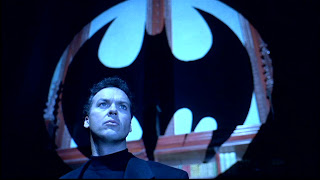
The iconography of a Batman film is present throughout Returns, often times less in-your-face than it is in the newer films or in 89’. For example: pimping the bat logo. There’s an unforgettably moronic shot in Batman 89 where the Batwing flies past the moon and creates the bat logo. Not only does this defy physics, but it’s superfluous. Even less realistically, the Begins Bat signal is comprised of a prisoner wearing cut rags tied to a searchlight. How about a nice way to tie in the iconic logo and the bat signal without shoving it down our throat like the simple shot of Wayne reading in Returns when the logo shines through the window and he stands up and looks at it. It’s simple. It’s effective. It’s purely badass. Some would say that the shape of the bat signal is too precise…I have to argue, does that matter AT ALL? Like I mentioned before, realism flies out the window period in comic book films, so the logistics of the shape of bat signal are much less relevant than the source of the logo being from a tormented Arkham escapee or an idiotic shot of the batwing blocking the moon. Also part of the Batman iconography in addition to the obvious batsuit, is the Batmobile. While the design of the Batmobile is introduced in 89, the scenes with it are a bit unceremonious and don’t really show off the sleek awesomeness of the vehicle to its full potential. There’s something very “constructed” and fake about it as it cruises through the streets tipping fruit stands. In Returns, it’s a viable threat when it’s under the penguins control, driving recklessly through streets and smashing cars at top speed. Then in one of the single greatest and most innovative comic book movie moments I can think of, the Batmobile splits off the sides into the “Batmissile” to squeeze through a narrow gap between two buildings. It’s this same kind of enthusiasm you see in the “Batpod” scene of The Dark Knight that really makes the truck chase scene stand out. It’s Batman being one step ahead, and ready for anything.

Which brings me to refute another fault of the film, is that The Penguin isn’t a credible threat to Batman. Physically, he never was, and never should be, even in comics. The appearance of the character, deformed physically and mentally in Burton’s vision immediately creates a more formidable presence than anything prior in the comics or other adaptations. The audience fears the Penguin. He admonishes the viewer for treating him differently. First invoking feelings of fear, then pity, and then feelings of hate, the same cycle of emotions that Shreck and the other denizens of Gotham feel towards Penguin in the film. Batman, ever-vigilant is never scared of The Penguin because he knows what he has to do to stop him. Despite his confidence, The Penguin still manages to nearly kill Batman several times in the film, including the Batmobile bomb, an umbrella gun at the end and with the penguin commandos.

One of my friends in particular, a fellow Batman enthusiast faults the film the most for the inclusion of the “penguin commandos” aka live penguin army that lives in the sewer and eventually waddles into the streets of gotham with rocket launchers strapped to their backs while responding to a frequency signal. I think given the absurd nature of the rest of the film, this fits in pretty well. With every failed attempt, the Penguin continues to get angrier and angrier at Batman until he goes to an extreme which he’s clearly had in reserve for a long time coming. This is every bit as dangerous, if not more so than the Joker spraying the city with laughing gas from parade balloons or say…fear toxin in the water supply. If anything I would say that this is slightly more believable than those. If you’re asking how penguin could have possibly acquired the resources, then you also have to ask yourself how The Joker is able to employ Police Officers in The Dark Knight and plant a bomb inside of an inmate while unarmed inside of a holding cell. There’s certain things you just have to accept because like it or not…Batman is still based on a comic book, and like I said earlier, comic books serve to tell stories in a visually appealing way which you couldn’t find elsewhere. As Returns plays out like a big screen comic complete with it’s own artistic style, taking the penguin commando army in stride should be easy to get past after the first five minutes of seeing a baby eat a cat and get tossed into a sewer. At worst you can laugh at these “lighter” deaths and at best you can build a hatred of The Penguin’s pathetic character. The pathos are all there. I would say that there’s less suspension of disbelief involved in frequency controlled penguins than Doc Ock controlling tentacles with his “brain chip” in Spiderman 2…or even the concept of a Spider bite giving someone super powers. I don’t see how it could be difficult to accept, especially in a universe as absurd as Batman’s.

So I’ve written a lot now trying to defend Returns from various possible criticisms (Why do people always bring tomatoes to speeches?) but what sets it apart from the rest? I can safely say that personally, as a lifelong Batman fan, Returns may be the most enjoyable Batman film to me. While for nostalgic reasons, The Dark Knight is still the most fun I ever had with a film given all the hype surrounding the release, Returns is worth a watch if you can overlook the lack of Nolan.

It’s the perfect mix of comic Batman characters with elements of movies ranging from comedy to horror. The suit is there. The tech is certainly there (remote controlled batarang anyone?). The action sequences are tight and well edited. On top of that, it also has my personal favorite musical score of all time for a film. Dark brooding, moody circus music perfectly fits the character of the Penguin and the slinky, screeching effects suit Catwoman’s character very well. Elfman also expands on the already great Batman theme from 89 and mixes the best cues when Batman is on screen with heightened versions of the Penguin suite when the characters are intercut on screen (such as the pursuit of the penguin through the sewers in the third act).

Speaking of the pursuit scene…out of all the secondary bat vehicles introduced in the third act of the Batman films (Batplane, Batwing, Bat sub, Batpod, Bat…sled…) the Batskiboat which narrowly dodges wayward missiles from Penguin Commandos is by far the coolest and most practical. There’s this great overwhelming presence of the absurd in Batman Returns, but the subject matter is so dark (I’ve heard people compare the film to an inkwell) that it’s hard to laugh at it. I think it’s a great mix for a Batman movie. It’s sad, often poignant at times, but also tends to feel like a sitcom akin to the 1966 Batman show crossed with the Addam’s Family. It’s a perfect cross between darkness and camp…beauty and the beast if you will.

One of the greatest scenes in the film is the death of the Penguin. After he has supposedly fallen to his watery grave through glass, he emerges dripping blood and bile from the water behind Batman, in one final attempt to kill him. He reaches for an umbrella, and accidentally "picks a cute one" before collapsing needing a "cold drink of ice water." Hated by everyone his entire life, in his death, the penguins emerge from the corners of his sewer lair and drag him into the water to sink to the bottom. It's touching, bizarre even to Batman, who watches the procession unfold. The music is powerful, sad and extremely fitting. It's incredible to see an incredibly humanizing and tragic end to a character that is so easy for most people to hate throughout the film.

Rather than just elude to the accepted truths of the Batman mythos like the super-urban high tech current films, grim to the core, I think Batman Returns is a good superhero film that’s certainly worth watching again if you feel like it’s “stupid” or not a “batman film.” I wish I could have spent more time praising the nuances in Devito’s performance or the greatness of Catwoman’s role in this film as the only truly well written female character in the Batman series’, but the pitiful legacy Returns has acquired among comic fans made this more of a crusade to set the record right. Though I would hardly call myself a Returns apologist…as there’s nothing to be sorry for. This is an excellent film.

"Come what may...Merry Christmas Mr. Wayne..."

"Merry Christmas Alfred. Goodwill toward men. And women."

My review of Super 8: marketing a film as retro doesn't mean it needs to be more of the same

To contact us Click HERE
Seeing a mob of confused people with failing electronic devices and flickering electricity in J. J. Abram’s newest virally-marketed flick, Super 8, I couldn’t help but be reminded of an episode of Rod Serling’s Twilight Zone with an episode called The Monsters are Due on Maple Street. In the classic episode, panicked townsfolk turn to the knowledge of a child who has read too many fantasy stories to guide them through the panic of an alien invasion. Ultimately the twist makes a statement and isn’t something you saw coming, which was always the case with the classic series. Sadly, with Super 8 and its equally mysteriously marketed predecessor Cloverfield from 2008; there is no twist, and the “surprise” of the films is exactly your first thought from the trailers.

The film opens with the protagonist, a young boy named Joe losing his mother and then flashes forward a few months to a group of enthusiastic young film makers attempting to film a zombie movie with a Super 8 camera. For “production value” they film a train as it’s passing by and it happens to explode multiple times. Before you know it the military is involved and it’s up to Joe’s father, the local sheriff, as played by Kyle Chandler (who seemingly holds the position of every other elected official in the town and conducts one-man press conferences) to save the world. Of course since the loss of his wife there has been some distance between him and his son and this alien disaster is just the kind of therapy their father-son relationship needed to bring them together in a one-dimensional and forced emotional arc.

It’s not the only shallow and uninteresting relationship in the movie though. Joe also quickly falls in love with a girl named Alice (Elle Fanning) applying monster make up on the film shoot and is willing to risk his life in the subsequent days to find her when she goes the way of the local dogs and appliances-missing. Scenes of Joe showing Alice footage of his mother and their bizarre under-age bonding experiences are where the film really tends to drag, though the action scenes are equally underwhelming and should serve to prove that the more explosions, thrashing tentacles and spastic unintelligible motion sequences you have in a movie doesn’t add to its stark and tasteful ambiguity, it only leaves the viewer slightly bored.

While it’s true, the use of child protagonists harkens back to older Speilberg films, you have to wonder how they became like a kid version of the A-team. One is a master of pyrotechnics, another a make up artist, one a brilliant actress and the other with an eye for storytelling. This premise unto itself, might have actually been more interesting than the wanton destruction and government conspiracies. Instead I’m left wondering why the film was marketed as if it were framed through a Super 8 camera and the logo of the film focused so much on that, as that plot line quickly devolves after the first 20 minutes until it’s no longer existent or relevant by the end of the film. While protagonists like Elliot in E.T. were able to stand alone in the 80’s and create a dramatic arc without forced drama, it was somehow necessary for Joe to be grieving the loss of his mother and making a film and falling in love prematurely to create a fully dynamic backdrop for alien invasion. And that aspect is nothing we haven’t seen before.

Super 8 borrows techniques and plot devices from tons of other films; from the accidental death of the mother as the result of the carelessness of a side character ala Signs to the government involvement of District 9, Super 8 felt like a movie that I’d seen before which added nothing new to the table. Some critics have said that if it was made in the 80’s it may have been a classic. I think it’s a little unfair to say that, because just about every movie that comes out now with advanced visual effects would have been as well. It feels slightly lazy to fall back on the draw of the film being a period piece with nods to older bodies of work to attempt to validate it. The movie magic surrounding Star Wars, E.T., Close Encounter of the Third Kind, and more is because those films really did something special that added to the ever changing medium of film and brought a new spectacle to the table. As much as I love homage’s to older movies and film connections, Super 8 just feels cut-and-dry and lifeless with no true emotional drive at the core and no genuine need to see how it ends, because you’ve seen it so many times before and you’re certain that all the characters will be fine. For a director that boasts such bold new visions, I can’t help but feel like this film is remarkably predictable and safe.

Toward the beginning of the film before disaster/invasion movie tropes became rampant and monotonous, the screenwriter of the group of kids is explaining how he read books on screenwriting and how you need to write in a love interest. When asked why he can’t supply a real reason other than “That’s how it works.” Thus Elle Fanning’s character is introduced into the zombie film. Ironically she exists in Super 8 for the same reason. For a movie apparently so aware of clichés it never made one attempt to avoid them or deviate from that little how-to guide to screen writing.